
Stamped Concrete That Turns Heads Right Here in Kent
Kent Concrete Works designs and installs custom stamped concrete surfaces for homeowners in Kent and throughout Portage County.
300+
Projects Completed
4.9 ★
Average Google Rating
15+
Years in Business
Concrete That Looks Like It Cost Twice as Much
Stamped concrete occupies a unique position in the world of outdoor surfaces. It delivers the durability, low maintenance, and longevity of standard concrete while adding a level of visual sophistication that plain grey slabs simply cannot match. Through the use of textured stamping tools pressed into the concrete before it sets, combined with color applied either integrally throughout the mix or as a surface hardener, stamped concrete can closely replicate the appearance of natural stone, slate, brick, cobblestone, and a range of other premium materials at a fraction of the cost of installing those materials individually.
For homeowners in the Kent area who want an outdoor living space that makes a genuine visual statement, stamped concrete is one of the most cost-effective ways to achieve that result. A stamped patio attached to the back of your home transforms the space from a functional afterthought into a genuine extension of your living area, one that looks intentional, polished, and well-designed. The same applies to stamped driveways, pool decks, walkways, and front entries. Whatever surface you are working with, the right stamp pattern and color combination can completely change how the space reads from a visual standpoint.
Is Stamped Concrete the Right Choice for Your Project?
Stamped concrete is an excellent choice for a wide range of residential applications, but it is worth understanding where it performs best and what trade-offs come with the territory before committing to it for your project.
Patios are the most common application and arguably the strongest fit. A stamped patio attached to the back of your home creates an outdoor living area with real visual character that holds up through decades of use with reasonable care. Driveways are another popular application, particularly for homeowners who want the street presence of a premium surface material without the ongoing maintenance demands of pavers or natural stone. Front entry walks and steps in stamped concrete create a strong first impression that complements a well-maintained home exterior. Pool decks benefit from stamped concrete as well, particularly because the textured surface provides better slip resistance than a smooth slab.
It is also worth being direct about the maintenance side of stamped concrete. Unlike plain concrete, stamped surfaces require periodic resealing to maintain their color vibrancy and protect the surface from moisture penetration and UV fading. In northeastern Ohio, where freeze-thaw cycles put real stress on surface sealers, resealing every two to three years is a reasonable expectation. The sealer is also what gives stamped concrete its characteristic sheen, and a surface that has gone too long without resealing will look dull and faded compared to how it looked when it was new. For homeowners who are willing to commit to that basic maintenance schedule, stamped concrete delivers outstanding long-term value. For those who want a completely set-and-forget surface, a standard brushed concrete finish may be a more practical choice.
How Stamped Concrete Is Installed: The Full Process
Installing stamped concrete correctly requires a higher level of skill, coordination, and timing than a standard concrete pour, and it is one of those services where the gap between an experienced contractor and an inexperienced one shows up clearly in the finished product.
The process begins the same way any quality concrete project does: with thorough site preparation. Existing surfaces are removed if necessary, the base is graded and compacted to the correct depth, and forms are set to establish the shape and perimeter of the project. For stamped concrete specifically, getting the base and forms right is even more important than usual because any inconsistency in the slab support will be visible in the finished decorative surface.
Once the site is prepared, concrete is poured and screeded to the correct level. Color hardener, if being used as the primary coloring method, is broadcast evenly across the surface and worked in during the floating process. Integral color mixed directly into the concrete is an alternative approach that produces a more consistent color throughout the full depth of the slab rather than just at the surface. A release agent is then applied over the surface, serving a dual purpose: it prevents the stamping tools from sticking to the concrete and adds a secondary color contrast that gives the finished surface its depth and dimensional appearance.
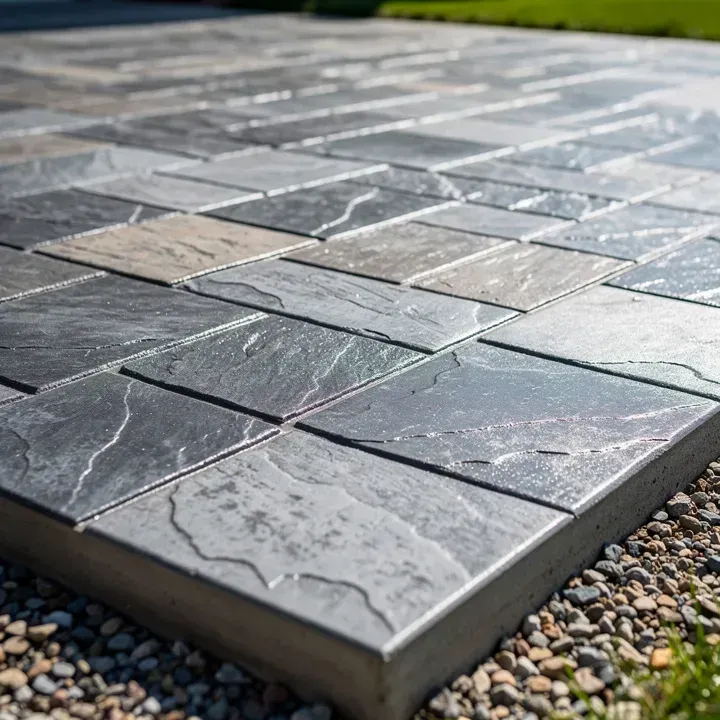
The stamping phase is the most time-sensitive part of the entire process. Once the concrete has reached the right consistency, the stamping tools are pressed firmly and evenly into the surface in the planned pattern, working systematically across the full area before the concrete sets. This phase requires an experienced crew working efficiently and in coordination to ensure the pattern aligns correctly, the texture impression is consistent, and no areas are missed or stamped at the wrong time. Concrete that is stamped too early will not hold the impression cleanly. Concrete stamped too late will not accept the tool at all.
After stamping is complete and the concrete has cured to the appropriate strength, the surface is cleaned, and a protective sealer is applied. The sealer locks in the color, enhances the visual depth of the pattern, and protects the surface from moisture, staining, and freeze-thaw damage going forward. Kent Concrete Works uses quality sealers appropriate for Ohio's climate and applies them at the correct coverage rate to ensure the protection they provide is genuine and lasting.
What Drives the Cost of a Stamped Concrete Project?
Stamped concrete costs more than standard concrete, and understanding why helps homeowners evaluate quotes and make informed decisions about where to invest in their project.
The base cost of stamped concrete reflects the additional materials and labor involved compared to a plain finish. Color hardeners or integral pigments add material cost. Release agents, stamping tools, and the sealer application all add to the overall project expense. The labor involved in a stamped pour is also more intensive than a standard pour due to the coordination required during the stamping phase and the skill needed to execute it correctly.
Pattern complexity is a meaningful cost variable. Simple repeating patterns like a standard ashlar slate or running cobblestone are more straightforward to execute than intricate custom designs with multiple border patterns, medallions, or color combinations. More complex designs require more tool sets, more precise layout work, and more time on site. Color selection also plays a role. A single base color with a standard release is the most economical approach. Multiple colors, custom color blending, or an antiquing finish that creates a more varied, natural-looking result add to the material and labor cost but produce a noticeably more distinctive finished surface.
Project size, site accessibility, and base preparation requirements all factor into the final price in the same way they do for any concrete project. Kent Concrete Works will walk you through pattern and color options during your free estimate and give you a clear picture of what each combination will cost so you can make a decision that fits both your vision and your budget.
Frequently Asked Questions
How does stamped concrete hold up through Ohio winters?
Stamped concrete holds up well through Ohio winters when it is properly installed and maintained. The most important factor is keeping the surface sealed. A quality sealer applied every two to three years prevents moisture from penetrating the surface and causing freeze-thaw damage. Avoid using rock salt or harsh deicing chemicals on stamped surfaces as these break down the sealer and can cause surface discoloration and deterioration over time. A concrete-safe ice melt product is the better choice for winter traction.
Can stamped concrete be repaired if it cracks or chips?
Minor surface chips and shallow cracks can be repaired using color-matched patching materials, though repairs on decorative surfaces are rarely completely invisible. The pattern and color matching required makes repairs more complex than on plain concrete. This is one reason why investing in proper installation from the start matters more with stamped concrete than with a standard finish. Structural cracks caused by base failure or significant ground movement are a more serious issue and may require section replacement. Kent Concrete Works will assess any damage honestly and recommend the most practical repair approach.
How often does stamped concrete need to be resealed?
In Ohio's climate, resealing every two to three years is a realistic maintenance expectation. The sealer is what protects the color and surface integrity of stamped concrete, and a surface that goes too long without it will begin to look faded and become more vulnerable to moisture damage. The exact interval depends on the amount of traffic the surface receives, sun exposure, and the type of sealer originally applied. Kent Concrete Works can reseal existing stamped surfaces in addition to new installations.
What is the difference between color hardener and integral color?
Color hardener is a pigmented powder broadcast onto the surface of freshly poured concrete and worked in during finishing. It produces a rich, dense color at the surface and adds strength to the top layer of the slab. Integral color is pigment mixed directly into the concrete before it is poured, producing consistent color throughout the full depth of the slab. If the surface chips or cracks, integral color shows the same tone all the way through rather than revealing grey concrete beneath. Both methods produce excellent results and can be used together for added color depth. Kent Concrete Works will discuss which approach best suits your project during the estimate.
Ready to Get Your Concrete Project Started?
Your concrete does not fix itself, and the longer a problem sits, the more it costs to address. If your driveway is cracking, your patio is pulling away from the house, or you have been putting off a project you know needs to happen, now is a good time to make the call. Kent Concrete Works offers free estimates with no obligation and no sales pressure. We come out, take a look, and give you a straight answer about what needs to be done and what it will cost. Contact us and we will be in touch shortly. Let us take care of the concrete so you do not have to think about it again.

Contact
(330) 578-7931
Mon–Sat: 7am–8pm
Kent, OH
About Us
Kent Concrete Works is a locally owned concrete contractor based in Kent, Ohio, serving homeowners throughout Portage County and the surrounding region including Summit and Stark County. We handle residential concrete projects of all sizes, from small sidewalk replacements to full driveway installs and foundation work. Every job we take on is completed with the same attention to detail, honest communication, and commitment to quality that has built our reputation here in northeastern Ohio. If you have a concrete project that needs to be done right, we would love to hear from you.
© Copyright 2026 Kent Concrete Works. All rights reserved.
© Copyright 2026 Kent Concrete Works.
All rights reserved.