
Concrete Sidewalks That Are Safe, Clean, and Built to Stay That Way
Kent Concrete Works installs properly finished concrete sidewalks for homeowners in Kent and throughout Portage County.
300+
Projects Completed
4.9 ★
Average Google Rating
15+
Years in Business
The Path to Your Front Door Says More Than You Think
The sidewalk leading to your front door is one of those features that people notice without consciously registering it. When it is clean, level, and well maintained, it contributes quietly to a positive first impression of your home. When it is cracked, uneven, or visibly deteriorated, it becomes one of the first things that draws the eye for the wrong reason. A broken or neglected walkway signals a lack of care for the property, even when everything else about your home is in good shape.
Beyond appearance, a sidewalk serves a straightforward practical purpose. It gives everyone who approaches your home a safe, stable surface to walk on. Family members, guests, delivery drivers, and service workers all use that path regularly, often without giving it much thought until something goes wrong. A raised section caused by frost heave, a crumbling edge, or a wide crack running across the path is a genuine trip hazard that puts people at real risk of injury. The liability that comes with an unsafe walkway on your property is not something most homeowners think about until it becomes a problem.
In some situations, the issue goes beyond personal liability. Homeowners whose property borders a public right-of-way may have a municipal obligation to maintain the adjacent sidewalk in a safe and passable condition. When the city or township determines that a sidewalk has deteriorated to the point of being hazardous, they can require the homeowner to repair or replace it within a set timeframe, sometimes with financial penalties attached for non-compliance. Addressing the problem proactively on your own timeline is almost always less stressful and less expensive than being compelled to do so under a municipal order.
When Should You Replace Your Sidewalk?
Concrete sidewalks in northeastern Ohio take a significant beating over their lifetime. The combination of heavy foot traffic, freeze-thaw cycles, ground movement from frost heave and tree roots, and years of exposure to deicing chemicals creates conditions that gradually break down even a reasonably well-installed slab. Knowing when a sidewalk has reached the end of its useful life versus when it can be repaired is a judgment call that depends on the nature and extent of the damage.
Hairline cracks that have not shifted vertically and are not widening are generally cosmetic and can be monitored without immediate action. However, cracks that have opened to more than a quarter inch in width, sections that have heaved or dropped creating a vertical offset at the joint, and areas where the surface is actively spalling or crumbling are clear indicators that the slab needs attention. When multiple sections are affected or when the damage is spread across a significant portion of the walk, replacement is typically more cost-effective than attempting piecemeal repairs that will need to be repeated as the remaining sections continue to deteriorate.
Tree roots are a particularly common cause of sidewalk damage in established neighborhoods throughout the Kent area. As roots grow and expand beneath the slab, they lift sections unevenly and create raised edges that are both visually obvious and physically dangerous. Cutting the roots and patching the lifted section can provide temporary relief, but if the root system continues to grow in the same direction the problem will return. In these situations, a more comprehensive solution that addresses both the concrete and the root interference is needed to produce a lasting result.
Our Process: From Removal to Finished Surface
Kent Concrete Works approaches every sidewalk installation with the same attention to detail and process discipline that we bring to larger concrete projects. The finished product may be smaller in scale than a driveway or patio, but the quality of the work underneath is exactly the same.
We begin by removing the existing concrete in full. Sections are broken out carefully to avoid disturbing surrounding landscaping, lawn areas, or adjacent structures where possible, and all material is hauled away from the site completely. Once the old concrete is out, we assess the condition of the base and address any issues with grade, drainage, or soil stability before proceeding. If tree roots contributed to the original damage, we discuss the options for managing them as part of the replacement process so the same problem does not recur in a shortened timeframe.
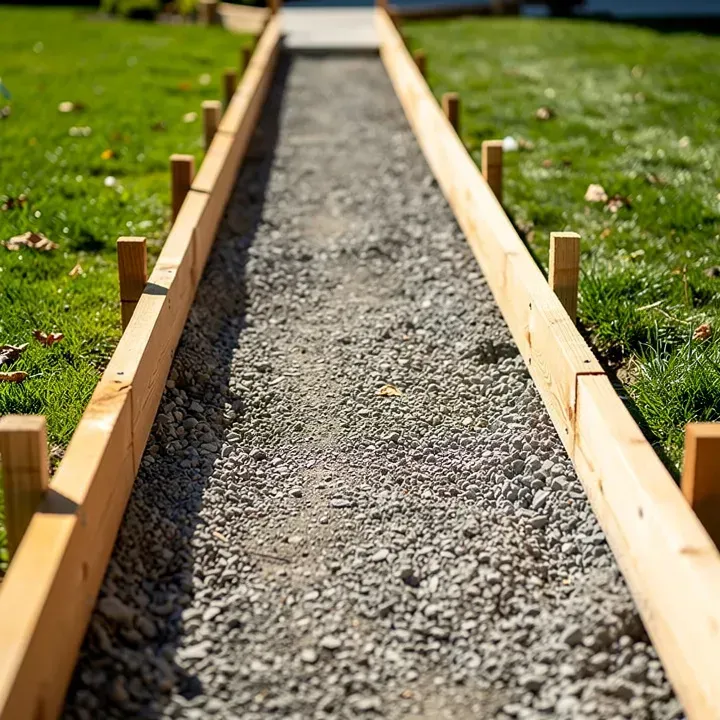
A properly compacted base is prepared to the appropriate depth, and the forms are set to establish the width, alignment, and grade of the new walk. Sidewalk grade is set with drainage in mind so that water moves off the surface and away from the house rather than pooling on the path or running toward the foundation. Concrete is poured, screeded, and finished with a brushed texture that provides reliable traction underfoot in wet and icy conditions, which matters considerably in an Ohio winter. Control joints are tooled at regular intervals along the length of the walk to manage slab movement and reduce the likelihood of random cracking between the joints over time.
The finished sidewalk is allowed to cure appropriately before foot traffic is permitted, and we leave the surrounding area clean and undisturbed. If any lawn or landscaping was affected during the installation process, we take care to restore those areas as much as conditions allow before we leave the site.
Understanding What Goes Into the Price
Sidewalk pricing is influenced by several factors that vary from one property to the next. The total linear footage and width of the walk are the primary cost drivers since they determine the total square footage of concrete required and the amount of labor involved in forming, pouring, and finishing the surface.
Removal and disposal of the existing concrete adds to the cost, particularly when the old slab is thick or when access to the site makes removal more labor-intensive. If the base beneath the existing walk is in poor condition and requires significant regrading or rebuilding, that preparation work adds to the overall scope of the project. Tree root interference, as discussed above, can also add complexity and cost depending on how extensively the roots have affected the base and the surrounding soil.
The straightforwardness of the layout plays a role as well. A simple straight run of sidewalk from the street to the front door is quick to form and pour. A walk with curves, steps, or transitions between different grades requires more forming work and more careful finishing. Finally, any decorative elements such as a broom finish variation, a colored border, or exposed aggregate accents will add to the price but can meaningfully improve the visual connection between the sidewalk and the overall appearance of the home. Kent Concrete Works provides clear estimates that reflect exactly what your specific project involves.
Frequently Asked Questions
Can you replace just one or two sections instead of the whole sidewalk?
Yes, partial replacement is a practical option when damage is limited to specific sections and the rest of the walk is in acceptable condition. We remove and replace the affected sections cleanly, matching the width and finish of the existing walk as closely as possible. Keep in mind that new concrete will appear slightly different in color from older sections initially, though the contrast typically softens over time as the new concrete weathers.
How do tree roots affect my sidewalk and what can be done about it?
Tree roots grow toward moisture and will lift and crack a concrete slab if they reach it. Once a root has caused significant heaving, simply patching the concrete over the root will not produce a lasting result. Depending on the tree species, its proximity to the walk, and the direction of root growth, solutions range from root barriers installed during replacement to rerouting the walk slightly to reduce future interference. Kent Concrete Works will assess the situation on site and recommend the most practical approach for your specific property.
Do I need a permit to replace my sidewalk in Kent?
Permit requirements vary depending on whether the sidewalk is entirely on private property or borders a public right-of-way. In many cases, replacing a private residential walkway does not require a permit, but work on or adjacent to public sidewalks may involve the city. Kent Concrete Works is familiar with local requirements in the Kent area and will let you know upfront if any permits are needed for your project so there are no surprises during the process.
Ready to Get Your Concrete Project Started?
Your concrete does not fix itself, and the longer a problem sits, the more it costs to address. If your driveway is cracking, your patio is pulling away from the house, or you have been putting off a project you know needs to happen, now is a good time to make the call. Kent Concrete Works offers free estimates with no obligation and no sales pressure. We come out, take a look, and give you a straight answer about what needs to be done and what it will cost. Contact us and we will be in touch shortly. Let us take care of the concrete so you do not have to think about it again.

Contact
(330) 578-7931
Mon–Sat: 7am–8pm
Kent, OH
About Us
Kent Concrete Works is a locally owned concrete contractor based in Kent, Ohio, serving homeowners throughout Portage County and the surrounding region including Summit and Stark County. We handle residential concrete projects of all sizes, from small sidewalk replacements to full driveway installs and foundation work. Every job we take on is completed with the same attention to detail, honest communication, and commitment to quality that has built our reputation here in northeastern Ohio. If you have a concrete project that needs to be done right, we would love to hear from you.
© Copyright 2026 Kent Concrete Works. All rights reserved.
© Copyright 2026 Kent Concrete Works.
All rights reserved.