
Concrete Foundations Poured Right From the Ground Up
Kent Concrete Works installs strong, properly reinforced concrete foundations for residential projects in Kent and throughout Portage County.
300+
Projects Completed
4.9 ★
Average Google Rating
15+
Years in Business
Your Entire Home Rests on This Single Decision
A concrete foundation is the single most consequential structural element of any building. Every wall, every floor, every roof load, and every piece of framing above grade ultimately transfers its weight down through the structure and into the foundation. When that foundation is properly designed, reinforced, and poured, it performs its job invisibly for decades without demanding attention. When it is not, the consequences work their way upward through the entire structure in ways that are expensive, disruptive, and sometimes irreversible.
For homeowners in the Kent area, foundation quality is not an abstract concern. Northeastern Ohio's soil conditions, combined with significant seasonal frost depth and the moisture demands of a region that receives substantial precipitation throughout the year, create a foundation environment that demands competent execution. Expansive soils shift with moisture changes. Frost lines in this part of Ohio reach down far enough to affect footings that are not placed at the correct depth. Poor drainage around a foundation does not just cause wet basements. It exerts lateral pressure against foundation walls and contributes to cracking and inward movement over time. Getting the foundation right from the start is not optional. It is the most important investment you will make in the longevity of whatever sits on top of it.
When Do You Need a New Foundation?
Foundation work comes up in a number of different residential contexts, and not all of them involve a failing existing structure. New construction is the most straightforward scenario: a garage addition, a room addition, a detached outbuilding, or a new home all require a foundation poured before framing can begin. In these cases the goal is simply to get the foundation right the first time so that the structure built on top of it has a stable, code-compliant base that will perform for the life of the building.
Replacement or repair situations are more complex. Foundation walls that have developed significant cracks, sections that have bowed or shifted inward under lateral soil pressure, or footings that have settled unevenly due to soil movement or inadequate original depth all represent situations where professional evaluation and intervention are needed. In some cases, the damage is repairable through targeted reinforcement or stabilization. In others, a section of foundation wall or an entire footing system needs to be replaced to restore structural integrity.
Homeowners also contact Kent Concrete Works for foundation work related to basement conversions, crawlspace upgrades, and the addition of below-grade living space where an existing foundation needs to be extended, reinforced, or tied into new footings. Whatever the context, the starting point is always the same: an honest assessment of what the ground conditions, the existing structure, and the project goals actually require before any concrete is ordered.
How We Approach a Foundation Pour
Foundation work requires a higher level of planning and precision than surface concrete projects, and Kent Concrete Works approaches every foundation job with the thoroughness that level of responsibility demands.
Every project begins with a careful review of the site conditions. Soil type, drainage patterns, existing grade, and the planned load of the structure above all factor into how the foundation is designed and executed. Footing depth is determined based on local frost line requirements and the bearing capacity of the soil at the site. In Kent and throughout Portage County, footings need to be placed below the frost line to prevent the seasonal ground movement that causes foundations to shift and crack over time. Skipping this detail or underestimating the required depth is one of the most common causes of foundation failure in residential construction.
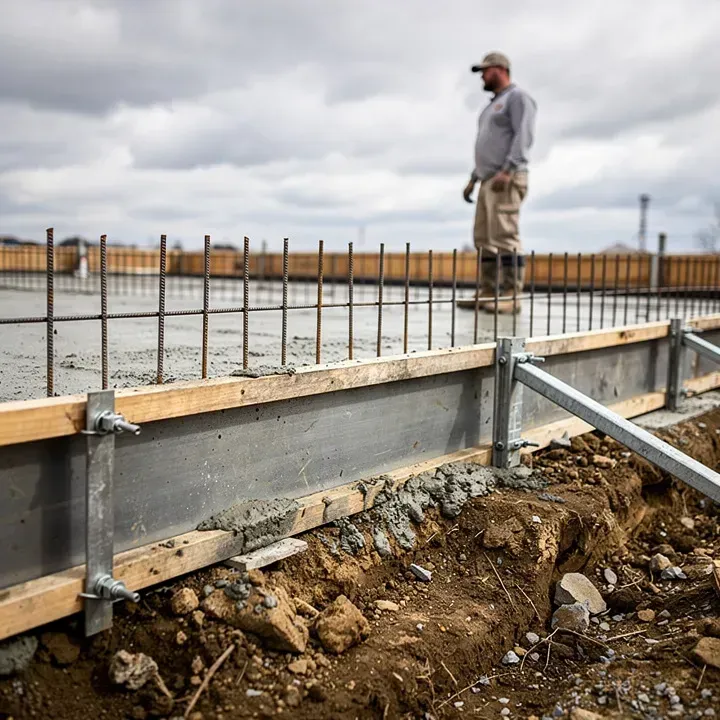
Excavation is completed to the required depth and dimensions, and the footing forms are set precisely to the planned layout. Rebar reinforcement is placed and tied within the footing forms before any concrete is poured. The reinforcement schedule, meaning the size, spacing, and configuration of the rebar, is determined by the structural requirements of the project and is not something we guess at or shortchange. Concrete is poured into the footing forms and consolidated properly to eliminate voids and ensure full contact between the concrete and the reinforcement.
Once the footings have reached adequate strength, the foundation wall forms are erected. Wall forms are set plumb, braced adequately to handle the pressure of the wet concrete pour, and checked for alignment before the pour begins. Concrete is placed in lifts and consolidated at each stage to prevent honeycombing and cold joints that would compromise the wall's integrity. After the walls have cured and the forms are stripped, the concrete is inspected and any surface voids are addressed. Waterproofing and drainage measures appropriate for the site conditions are applied or recommended before backfill is placed against the foundation walls.
Throughout the entire process, Kent Concrete Works maintains the standard of care that foundation work demands. This is not a project where cutting corners saves money in any meaningful way. The cost of correcting a poorly executed foundation after the structure above it has been built is orders of magnitude greater than doing it correctly the first time.
What Influences the Cost of a Concrete Foundation?
Foundation costs vary significantly from one project to the next because the variables involved are numerous and interconnected. Understanding the primary cost drivers helps homeowners approach the estimate process with realistic expectations.
The size and configuration of the foundation is the most obvious factor. A larger footprint requires more excavation, more forming, more reinforcement, and more concrete. A foundation with multiple corners, step-downs, or transitions between different wall heights is more complex to form and pour than a simple rectangular layout. The depth of the footings required for the specific site and frost conditions also affects the volume of excavation and the amount of concrete needed for the footing pours.
Soil conditions at the site play a meaningful role. Sites with stable, well-draining soil are more straightforward and less expensive to work with than sites with expansive clay soils, high water tables, or areas that require additional drainage measures to manage groundwater around the foundation. Rocky soil can significantly increase excavation time and cost depending on the equipment required to work through it.
Reinforcement requirements vary based on the structural loads the foundation will carry and any local code specifications that apply to the project. More heavily loaded structures or sites with challenging soil conditions may require a more robust reinforcement schedule, which adds to material and labor costs. Access to the site also affects cost. Tight lots, steep grades, or properties with limited equipment access require more effort to work around and may involve additional setup time or specialized equipment.
Finally, any waterproofing, drainage tile installation, or below-grade insulation requirements add to the total project cost but are investments that pay back over the life of the structure by keeping the foundation dry and thermally stable. Kent Concrete Works provides detailed estimates that break down each component of the foundation project clearly so you understand exactly what you are paying for and why.
Frequently Asked Questions
How long does a concrete foundation need to cure before framing can begin?
Concrete foundations are typically ready to begin framing after a minimum of seven days of curing under normal temperature conditions. Full design strength is reached at 28 days. In colder weather, curing slows considerably and the timeline may need to be extended. Rushing the framing schedule before the foundation has reached adequate strength risks damaging the concrete under load. Kent Concrete Works will give you a realistic curing timeline based on the conditions at the time of your pour.
How deep do footings need to be in northeastern Ohio?
Ohio's frost line in the northeastern part of the state typically requires footings to be placed at a minimum of 36 inches below finished grade, though local code requirements and specific site conditions can affect that number. Footings placed above the frost line are vulnerable to seasonal heaving as the ground freezes and thaws, which causes the foundation to shift and crack over time. Kent Concrete Works ensures all footings are placed at the correct depth for the site and in compliance with applicable local codes.
Do I need a permit for foundation work in Kent?
In almost all cases, yes. Foundation work is structural in nature and falls under building permit requirements in Kent and throughout Portage County. Permits ensure the work is inspected and meets local building code standards, which protects both the homeowner and anyone who purchases the property in the future. Kent Concrete Works is experienced with the local permit process and can help guide you through what is required for your specific project before work begins.
What is the difference between a poured concrete foundation and a concrete block foundation?
Poured concrete foundations are formed and poured as a monolithic wall, producing a stronger, more waterproof structure with fewer joints where water can infiltrate. Concrete block foundations are built course by course from individual masonry units and are more common in older homes throughout the region. Poured foundations are generally the preferred choice for new residential construction due to their superior strength and water resistance. Block foundations are still built in certain applications and can perform well when properly constructed and waterproofed. Kent Concrete Works handles both and will recommend the appropriate system for your project.
Ready to Get Your Concrete Project Started?
Your concrete does not fix itself, and the longer a problem sits, the more it costs to address. If your driveway is cracking, your patio is pulling away from the house, or you have been putting off a project you know needs to happen, now is a good time to make the call. Kent Concrete Works offers free estimates with no obligation and no sales pressure. We come out, take a look, and give you a straight answer about what needs to be done and what it will cost. Contact us and we will be in touch shortly. Let us take care of the concrete so you do not have to think about it again.

Contact
(330) 578-7931
Mon–Sat: 7am–8pm
Kent, OH
About Us
Kent Concrete Works is a locally owned concrete contractor based in Kent, Ohio, serving homeowners throughout Portage County and the surrounding region including Summit and Stark County. We handle residential concrete projects of all sizes, from small sidewalk replacements to full driveway installs and foundation work. Every job we take on is completed with the same attention to detail, honest communication, and commitment to quality that has built our reputation here in northeastern Ohio. If you have a concrete project that needs to be done right, we would love to hear from you.
© Copyright 2026 Kent Concrete Works. All rights reserved.
© Copyright 2026 Kent Concrete Works.
All rights reserved.