
Concrete Block Walls in Kent, OH
Lake City Concrete Services builds concrete block walls for homeowners across Lake City and Columbia County. Solid, durable, and built to define your property for decades.
300+
Projects Completed
4.9 ★
Average Google Rating
15+
Years in Business
More Than Just a Wall
A concrete block wall does more work on a residential property than most homeowners initially appreciate. Depending on where it is placed and how it is built, a block wall can retain soil on a sloped lot and prevent erosion that would otherwise gradually eat away at your yard and landscaping. It can define the boundary of your property with a clean, permanent structure that requires far less maintenance than a wood fence and outlasts it by decades. It can enclose a utility area, screen an unsightly section of the property, or create a raised planting bed that adds structure and visual interest to your landscaping.
Concrete block is a material that has been used in residential construction throughout northeastern Ohio for generations, and for good reason. It is strong, durable, resistant to rot and insect damage, and largely unaffected by the freeze-thaw cycles that cause other materials to deteriorate over time when properly constructed. A block wall built with the correct footing, proper mortar, and appropriate reinforcement where the application demands it is a permanent addition to your property that will outlast almost everything else on the lot.
What Situations Call for a Concrete Block Wall?
Homeowners in the Kent area reach out to Kent Concrete Works for block wall projects in a variety of different situations, and understanding the range of applications helps clarify whether a block wall is the right solution for your specific property challenge.
Retaining walls are the most structurally demanding application. When a yard has a significant grade change, whether naturally occurring or created by grading work done during construction, the soil on the high side of that grade change needs to be held in place. Without a proper retaining structure, that soil erodes gradually during rain events, migrates into lower areas of the yard, and can eventually undermine adjacent structures, driveways, or landscaping features. A concrete block retaining wall provides a strong, permanent structure that holds the grade cleanly and stops erosion at the source.
Property boundary and enclosure walls are less structurally demanding but equally permanent in nature. These walls define space, create privacy, screen utility equipment or storage areas, and add a sense of structure and intentionality to the property layout. Unlike wood fencing, a concrete block wall does not rot, warp, lean, or require painting or staining to stay presentable. It holds its appearance and its line year after year with virtually no maintenance beyond occasional cleaning.
Raised garden beds and landscape retaining walls are a popular application for homeowners who want to add structure and definition to their yard without taking on a large construction project. A well-built block wall around a raised planting area transforms an ordinary yard into one with genuine visual organization and makes the landscaping easier to maintain by keeping soil contained and defined.
Whatever the application, the structural requirements of the wall, specifically its height, the load it will carry, and the soil conditions it will interact with, determine how it needs to be built. Kent Concrete Works evaluates every block wall project on its own merits and designs the construction approach accordingly.
How We Build Concrete Block Walls
Building a concrete block wall that performs correctly over the long term starts well below the surface, with a footing that is properly sized, correctly placed, and poured at the right depth for the application and the frost conditions of northeastern Ohio.
Every block wall Kent Concrete Works builds begins with footing excavation. The footing is the continuous concrete base that supports the weight of the wall above it and distributes that load into the soil beneath. For retaining walls and any wall of significant height, the footing must be placed below the frost line to prevent seasonal ground movement from shifting or cracking the wall. The footing width and depth are sized based on the height and load requirements of the wall being built above it.
Once the footing has cured to adequate strength, block laying begins from the footing up. The first course is set carefully in a full mortar bed, leveled precisely, and checked for alignment before any subsequent courses are placed. Getting the first course right is critical because every course above it follows from it. Block is laid in a running bond pattern, meaning the vertical joints in each course are offset from those in the course below, which distributes load more effectively and produces a stronger wall than stacked joints would.
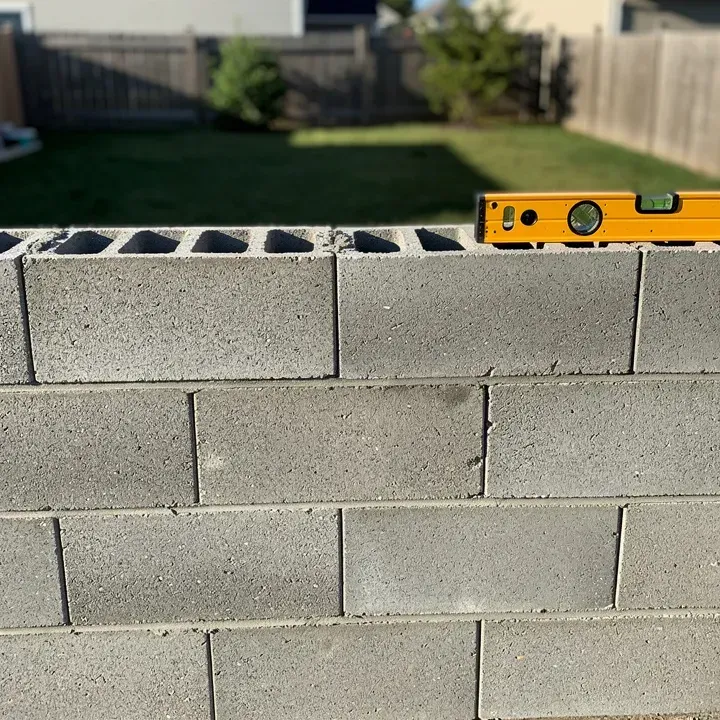
Mortar joints are tooled consistently as the work progresses to produce a clean, professional appearance and ensure proper bonding between the block and mortar. Where the wall height or application requires it, vertical cores in the block are filled with grout and reinforced with rebar to significantly increase the wall's resistance to lateral pressure and overturning forces. This is particularly important for retaining walls that will be holding back significant volumes of soil.
For retaining walls, drainage behind the wall is an aspect of the installation that is just as important as the wall itself. Without adequate drainage, hydrostatic pressure builds up in the soil behind the wall after rain events and can exert forces that no block wall is designed to resist indefinitely. Drainage aggregate and weep holes or drain tile installed behind the wall allow water to escape rather than accumulate, relieving that pressure and dramatically extending the life of the structure. Kent Concrete Works incorporates proper drainage into every retaining wall installation as a standard part of the process, not an optional add-on.
What Affects the Cost of a Concrete Block Wall
Block wall pricing varies based on a straightforward set of factors that relate directly to the scope and complexity of the project.
Wall length and height are the primary cost drivers. More block, more mortar, more labor, and a larger footing all follow directly from a longer or taller wall. Height in particular has a compounding effect on cost because taller walls require more robust footings, more reinforcement, and in the case of retaining walls, more attention to drainage behind the wall.
Footing requirements add to the cost in proportion to the wall's structural demands. A low decorative garden wall requires a modest footing. A tall retaining wall holding back a significant volume of soil requires a substantially more robust footing, which means more excavation, more concrete, and more labor in the foundation phase of the project.
Site conditions and accessibility affect how efficiently the work can be executed. A wall being built in an open, accessible area of the yard is straightforward to work on. A wall in a tight or hard-to-reach location requires more effort to get materials into position and may limit the use of mechanical assistance for block placement.
Reinforcement requirements, drainage provisions for retaining walls, and any capstone or finishing details applied to the top of the wall all add to the final cost but contribute meaningfully to the durability, functionality, and appearance of the finished structure. Kent Concrete Works provides clear, detailed estimates that reflect exactly what your specific wall project requires so there are no surprises when the work is complete.
Frequently Asked Questions
How tall can a concrete block wall be before it needs reinforcement?
As a general guideline, unreinforced concrete block walls should not exceed four feet in height for most residential applications. Beyond that height, the lateral forces acting on the wall, particularly for retaining walls holding back soil, require vertical rebar and grout fill in the block cores to provide adequate strength and stability. Local building codes may also specify reinforcement requirements based on wall height and application. Kent Concrete Works designs every wall with the appropriate level of reinforcement for its specific height and function.
Do concrete block retaining walls need drainage behind them?
Yes, and this is not optional. Without drainage behind a retaining wall, water that accumulates in the soil after rain has nowhere to go and builds up as hydrostatic pressure against the back of the wall. Over time that pressure can cause even a well-built wall to crack, lean, or fail entirely. Proper drainage aggregate, weep holes, or drain tile installed behind the wall during construction allows water to escape and relieves that pressure before it becomes a structural problem. Kent Concrete Works includes drainage as a standard part of every retaining wall installation.
How long does a concrete block wall last?
A properly built concrete block wall with an adequate footing and appropriate reinforcement where required can last 50 years or more with very little maintenance. The key factors are footing depth, mortar quality, reinforcement where needed, and drainage management for retaining applications. Walls that were built without proper footings or drainage tend to show problems within 10 to 15 years as the footing shifts or hydrostatic pressure causes cracking and leaning. Investing in correct construction from the start is what produces a wall that genuinely lasts.
Can a concrete block wall be built on a slope?
Yes, and it is a common scenario on residential properties throughout the Kent area where lots are not perfectly flat. Building on a slope requires stepping the footing down at intervals to follow the grade while keeping each footing section level. The block courses above each step are then built up to maintain a consistent wall height or follow the slope as the design requires. This stepped footing approach is standard practice for sloped sites and does not compromise the structural integrity of the wall when executed correctly.
Ready to Get Your Concrete Project Started?
Your concrete does not fix itself, and the longer a problem sits, the more it costs to address. If your driveway is cracking, your patio is pulling away from the house, or you have been putting off a project you know needs to happen, now is a good time to make the call. Kent Concrete Works offers free estimates with no obligation and no sales pressure. We come out, take a look, and give you a straight answer about what needs to be done and what it will cost. Contact us and we will be in touch shortly. Let us take care of the concrete so you do not have to think about it again.

Contact
(330) 578-7931
Mon–Sat: 7am–8pm
Kent, OH
About Us
Kent Concrete Works is a locally owned concrete contractor based in Kent, Ohio, serving homeowners throughout Portage County and the surrounding region including Summit and Stark County. We handle residential concrete projects of all sizes, from small sidewalk replacements to full driveway installs and foundation work. Every job we take on is completed with the same attention to detail, honest communication, and commitment to quality that has built our reputation here in northeastern Ohio. If you have a concrete project that needs to be done right, we would love to hear from you.
© Copyright 2026 Kent Concrete Works. All rights reserved.
© Copyright 2026 Kent Concrete Works.
All rights reserved.