
Concrete Driveways Built to Last
Kent Concrete Works installs durable, professionally finished concrete driveways for homeowners in Kent and throughout Portage County.
300+
Projects Completed
4.9 ★
Average Google Rating
15+
Years in Business
Your Driveway Works Every Single Day
A concrete driveway is one of the hardest working surfaces on your entire property. It bears the full weight of your vehicles every single day, absorbs the impact of northeastern Ohio winters without complaint, and serves as one of the most visible features of your home from the street. When it is in good shape, it performs its job quietly and adds genuine curb appeal without requiring much attention. When it starts to deteriorate, it becomes difficult to ignore and can reflect poorly on an otherwise well-maintained home.
Homeowners who invest in a properly installed concrete driveway get far more than a place to park. They get a surface that handles daily vehicle loads without cracking under pressure, sheds water correctly to protect the surrounding landscape and foundation, and holds up through decades of freeze-thaw cycles that would destroy lesser materials. Concrete is also low maintenance compared to alternatives like asphalt, which requires periodic resealing to stay in usable condition. A well-poured concrete driveway, properly jointed and finished, can realistically last 30 years or more with only basic care. For most homeowners, it is one of the best long-term investments they can make in their property.
When Repairs Stop Making Sense
Concrete driveways do not last forever, and in Ohio's demanding climate they tend to show their age faster than in parts of the country with milder winters. The combination of road salt, repeated freeze-thaw cycles, heavy vehicle loads, and years of moisture exposure takes a cumulative toll on even a well-installed slab. Knowing when to repair and when to replace is something homeowners often struggle with, and it is a question worth getting right because the wrong decision in either direction costs money.
If your driveway has visible cracks running across the surface, particularly those that are widening or have begun to shift vertically between sections, that is a sign the structural integrity of the slab is compromised. Sections that have sunk or heaved out of level indicate base failure beneath the concrete, which no surface repair can address in any lasting way. A surface that is flaking, pitting, or scaling from years of salt and moisture exposure means the dense protective layer of the concrete has been destroyed, leaving the more porous interior exposed to accelerating damage.
Homeowners sometimes delay driveway replacement because of the upfront cost, which is understandable. But a failing driveway does not sit still while you wait. The base beneath continues to erode, water finds its way deeper into the soil near your foundation, and sections that are merely cracked today become fully displaced tomorrow. What is a straightforward replacement project at one point becomes a more complicated and expensive job the longer it is postponed. Kent Concrete Works will come out, assess your driveway honestly, and tell you plainly what you are dealing with and what your best options are.
No Shortcuts: How We Pour a Driveway That Lasts
Every driveway installation Kent Concrete Works completes follows a deliberate, step-by-step process that is built around long-term performance rather than getting the job done as fast as possible. The work begins with full removal of the existing concrete. We break out the old slab completely and haul everything away from the site so you are not left with a pile of broken concrete to deal with. Once the old material is out, we take a careful look at the condition of the base beneath.
Base preparation is where most driveway failures begin, and it is where we invest the most attention. If the existing base is soft, poorly graded, or showing signs of erosion or drainage problems, we address those issues before a single yard of new concrete is ordered. A properly compacted gravel base is installed to the correct depth for the application, providing a stable, well-draining foundation that gives the new slab consistent support across its entire surface. We then set the perimeter forms to establish the shape, grade, and edge profile of the finished driveway.
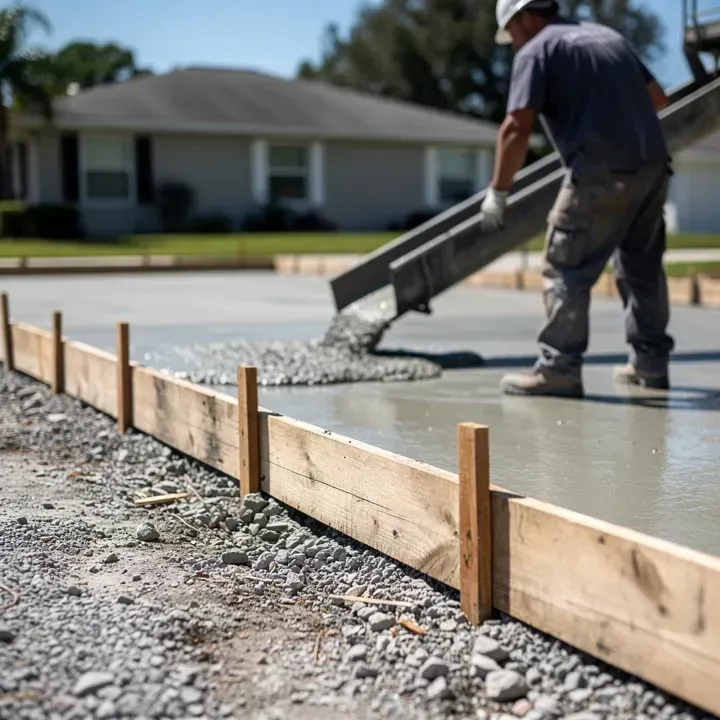
Reinforcement is placed where the project calls for it, and the concrete is poured using a mix selected for Ohio's climate conditions, one that balances workability with the durability needed to survive years of freeze-thaw stress. The surface is screeded, floated, and finished to the specified texture, typically a brushed finish that provides safe traction without looking rough or unfinished. Control joints are tooled or cut at calculated intervals to direct how the slab responds to natural movement and temperature changes over time, significantly reducing the likelihood of random cracking between the joints.
Once the pour is complete, the concrete is allowed to cure under appropriate conditions. We do not rush this stage. Proper curing is what allows the concrete to reach its full design strength, and cutting that time short produces a weaker surface that is more vulnerable to damage. Before we leave the site, we walk you through what to expect during the curing period and give you straightforward guidance on how to care for your new driveway going forward.
What Affects the Cost of a Concrete Driveway?
The cost of a new concrete driveway is not a single fixed number, and any contractor who quotes you a price without seeing your property is guessing. Several factors combine to determine what your specific project will cost, and understanding them helps you evaluate quotes and make a confident decision.
Size is the most straightforward variable. A larger driveway requires more concrete, more labor, and more time. Width, length, and any additional apron areas or turnarounds all factor into the total square footage and therefore the overall price. Thickness also plays a role: a driveway designed to support heavier vehicles requires a thicker slab and more material than a standard passenger vehicle driveway.
The condition of the existing driveway and the base beneath it affects the scope of the removal and preparation work. A slab that is heavily deteriorated or sitting over a compromised base takes more time and effort to address properly before new concrete can go down. Site accessibility matters as well. Driveways that are difficult to reach with a concrete truck or that require extended chute runs or pump truck access add logistical complexity and cost.
Decorative finishes such as exposed aggregate, integral color, or a stamped border section increase the price but also meaningfully elevate the appearance and perceived value of the finished product. Finally, current material pricing and the specific mix design required for your project conditions will influence the final number. Kent Concrete Works provides clear, detailed estimates that break down exactly what you are paying for. There are no vague line items and no surprises when the invoice arrives.
Frequently Asked Questions
How long do I need to stay off the driveway after it is poured?
Freshly poured concrete needs time to gain strength before it can handle load. We recommend keeping foot traffic off the new driveway for at least 24 to 48 hours after the pour. Vehicles should stay off for a full seven days minimum, and ideally longer during colder weather when curing slows down. Driving on concrete before it has reached adequate strength can cause surface damage and permanent marks that cannot be repaired without patching. We will give you clear instructions specific to your project and the weather conditions at the time of your pour.
Can my existing driveway be resurfaced instead of replaced?
In some cases, yes. If the existing slab is structurally sound with no significant cracking, sinking, or base issues, a resurfacing overlay can refresh the appearance and extend the life of the driveway for several more years. However, resurfacing is only a viable option when the underlying slab is still in good condition. Applying a new surface over a failing slab will not solve the underlying problem and will typically fail within a short period of time. We will give you an honest assessment of whether resurfacing makes sense for your driveway or whether replacement is the better investment.
How thick should a residential concrete driveway be?
For a standard residential driveway used by passenger vehicles, a slab thickness of four inches is the common minimum. If the driveway will regularly support heavier vehicles such as trucks, RVs, or loaded trailers, five to six inches is a more appropriate thickness. Proper thickness combined with a well-compacted base is what gives a driveway its load-bearing capacity and long-term durability. Kent Concrete Works will recommend the right thickness for your specific situation based on your vehicle use and site conditions.
Ready to Get Your Concrete Project Started?
Your concrete does not fix itself, and the longer a problem sits, the more it costs to address. If your driveway is cracking, your patio is pulling away from the house, or you have been putting off a project you know needs to happen, now is a good time to make the call. Kent Concrete Works offers free estimates with no obligation and no sales pressure. We come out, take a look, and give you a straight answer about what needs to be done and what it will cost. Contact us and we will be in touch shortly. Let us take care of the concrete so you do not have to think about it again.

Contact
(330) 578-7931
Mon–Sat: 7am–8pm
Kent, OH
About Us
Kent Concrete Works is a locally owned concrete contractor based in Kent, Ohio, serving homeowners throughout Portage County and the surrounding region including Summit and Stark County. We handle residential concrete projects of all sizes, from small sidewalk replacements to full driveway installs and foundation work. Every job we take on is completed with the same attention to detail, honest communication, and commitment to quality that has built our reputation here in northeastern Ohio. If you have a concrete project that needs to be done right, we would love to hear from you.
© Copyright 2026 Kent Concrete Works. All rights reserved.
© Copyright 2026 Kent Concrete Works.
All rights reserved.